The future of car interiors? Ask London studio NewTerritory
Look back at the evolution of car construction and styling over the course of a century and the progress is evident. Today’s cars are styled like spaceships compared to the boxy, top-heavy motorised carriages of old. But when it comes to interiors, the evolution has been a little slower. Inspect the cockpit of a 1912 Rolls-Royce and you’ll likely find four or more forward-facing seats, quilted leather, wood trim, milled metalwork, intricate dials, a clock, pedals, a gear lever and a steering wheel. It might be a little low-tech and drafty compared with the modern-day equivalent, but the format remains much the same.

Luke Miles of NewTerritory
(Image credit: NewTerritory)
‘Historically, car interiors have been designed as singular, controlled environments, offering occupants a unique, hermetically sealed experience,’ says Luke Miles, founder of brand-experience studio NewTerritory. ‘While exterior design often represents the brand, the interior has been a missed opportunity for delivering more meaningful, multi-sensory experiences.’

NewTerritory’s Re:Frame Sustainable Seat Design concept
(Image credit: NewTerritory)
Formally head of design for Virgin Atlantic and LG Europe, Miles founded London-based NewTerritory in 2017, which specialises in experience design for transport brands such as Delta Air Lines and Mercedes-Benz AG. The Clerkenwell studio is awash with design literature, intriguing samples and mock-ups of an aircraft cabin and a car’s cockpit. It’s no surprise this buzzy townhouse studio caught the attention of US experience consultancy Geniant, which acquired it in July 2025.

NewTerritory’s studio in Clerkenwell
(Image credit: NewTerritory)
Inside the studio, Miles and his team work across a variety of top-secret transport-related products and solutions for well-known brands, all designed to take interior spaces into the next level, instil that particular brand’s ideals on those travelling and, all being well, give them a positive experience to write home about. Not all that easy when your audience of travellers is either busy, distracted, stressed or all of the above.

Prototyping at the NewTerritory studio
(Image credit: NewTerritory)
‘Historically we’ve done a lot of work in aviation spaces, which are very high-density experiential spaces, with an audience that’s captive for a long time. But with automotive, it’s different – you’re in a sealed environment and have complete control over your climate and what’s going on around you,’ says Miles. ‘Other than just the physicality of the interior, we’re looking at how can you pull in more of the senses to deliver an experience that is meaningful and memorable.’

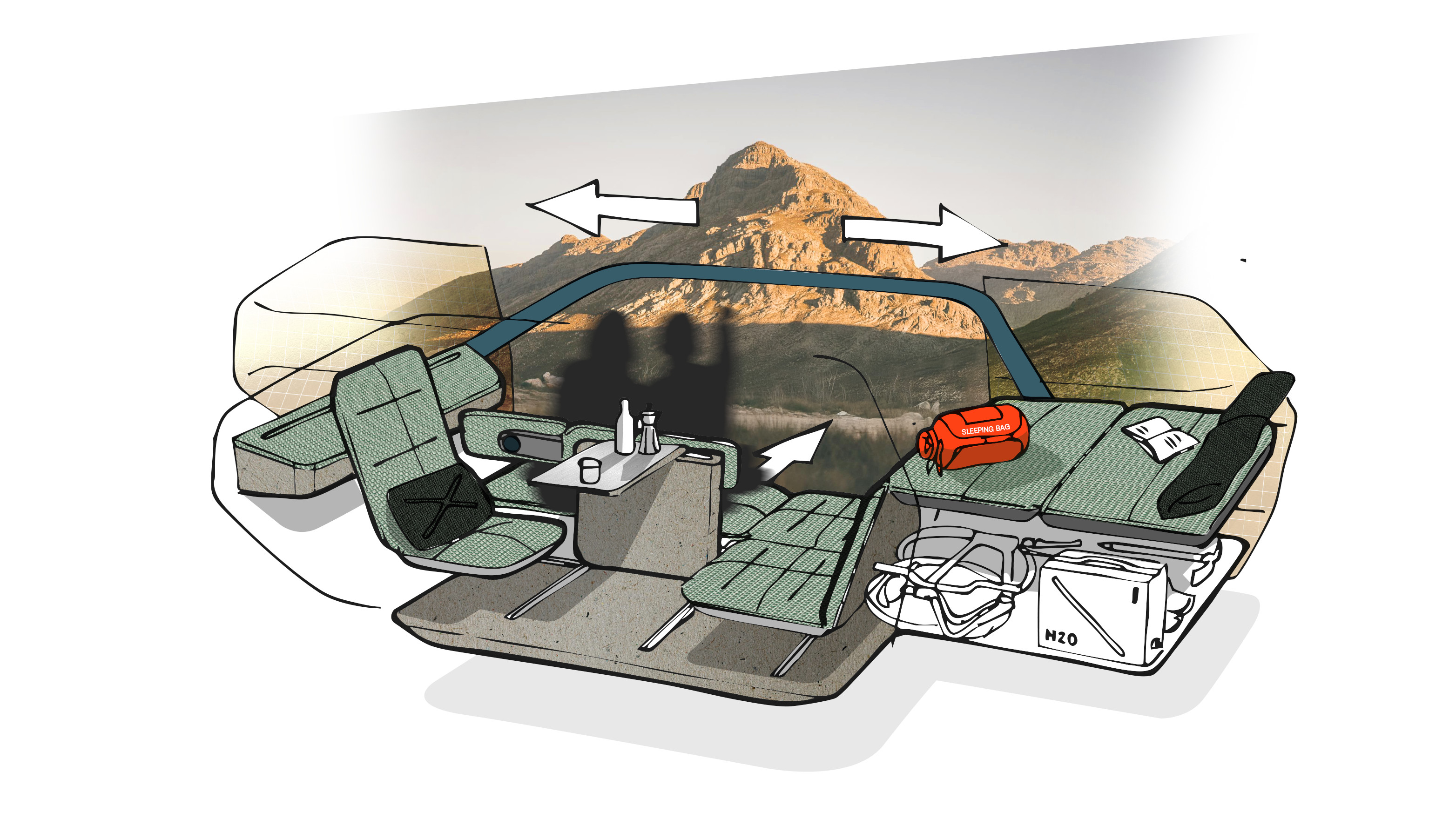
A sketch of NewTerritory’s Kinetic Soul Concept interior
(Image credit: NewTerritory)
While the structure and format of car interiors hasn’t changed much in a century, it hasn’t dampened carmakers’ appetite for experimentation. In 2013, Mercedes made in-car fragrance diffusers mainstream when it incorporated its Air-Balance package into the S-Class, which pumped scents such as ‘Nightlife Mood’ or ‘Downtown Mood’ from refillable cartridges into the cabin.

Mercedes introduced an in-cabin scent dispenser in 2013
(Image credit: Mercedes-Benz)
Despite it being a slightly more upmarket take on the air freshener dangling from the rear-view mirror, Mercedes still uses fragrance, alongside sound, climate, lighting and seat massage functions, to ‘boost driver wellbeing’, as part of its comfort programmes in cars like the all-electric EQS. It’s as full-on as it sounds, particularly when accidentally triggered it on a quiet motorway stretch at night.

Mercedes-Benz EQS Interior
(Image credit: Mercedes-Benz)
At Jaguar Land Rover, the Range Rover Sport SV saw the arrival of the ‘Body and Soul Seat’ (BASS) in 2024, which plugs into the entertainment and vibrates the seat to the music – something that was added to the new Defender OCTA also. While both Mercedes’ and JLR’s in-cabin innovations can be passed off as slightly eccentric novelties, there is one aspect of car interior innovation that all carmakers have homed in on: the screen.

Land-Rover Defender OCTA interior
(Image credit: JLR)
‘There’s this kind of centre of gravity pull towards the screen, which has led to screen dominance,’ says Miles. ‘There’s so much you could do sensorially with that space. It’s not about just chasing technology and going for screens because they’re there, but about trying to be more quiet, sensitive and empathic with how that vehicle communicates with you. It’s hard to demonstrate a brand through the screen because it becomes this midpoint where you can’t really tell one from the other,’ he adds.
In its place, Miles argues light, sound and haptics can all provide information to the driver and passengers in the right way and at the right time, without the need for information being channelled through the screen.
‘The interesting thing is to be able to quieten down the interior and then bring information up as required, rather than have it permanently there’
NewTerritory’s Luke Miles on screens

Model-making at the NewTerritory studio
(Image credit: NewTerritory)
‘The interesting thing is to be able to quieten down the interior and then bring information up as required, rather than have it permanently there.’ When it comes to changing the traditional structure of the cabin, Miles sees autonomy as the biggest enabler. ‘When cars reach level five autonomy, which requires no human intervention, then the cabin space can move from being directional to being more dynamic – you can reorientate the interior in a completely different way.’

Mercedes x Belmond Hotel on Wheels: Vision Pullman Express concept by Arya Kani
(Image credit: Arya Kani)
Not so long ago, when autonomous cars were expected on the roads by the early 2020s, car manufacturers rushed out with concept cars that showed occupants sleeping, watching films and facing each other in a lounge-like setting. In January 2025, transport design student Arya Kani dreamt up the Mercedes x Belmond Hotel on Wheels: Vision Pullman Express, which envisaged a futuristic fastback that doubled as a mobile hotel suite.

Mercedes x Belmond Hotel on Wheels: Vision Pullman Express concept by Arya Kani
(Image credit: Arya Kani)
‘There’s somehow a tension between traditional automotive language, which has dynamism, direction and speed to it, versus the more domestic setting,’ says Miles. ‘This autonomous technology might give rise to new typologies and vehicle – not just in terms of private shared ownership but with the provision of services,’ he adds, going on to explain how entirely new types of vehicles could reshape the idea of mobile healthcare, food delivery or, as Kani’s concept showcases, hospitality.

Model-making at the NewTerritory studio
(Image credit: NewTerritory)
‘That could be incredibly valuable in certain locations where you might not have the infrastructure to allow people to move from their homes to a more densely populated city, so you could take those services out to them,’ says Miles.
When it comes to technology a little closer to reality, Miles sees a switchback to more analogue controls, particularly in luxury automotive – not just so people can turn something by knowing where the switch is but, ‘through the tactility of those micro interactions, you can also get a sense of the craftsmanship of that vehicle, which maybe lost digitally’.

The interior of the Ferrari Amalfi
(Image credit: Ferrari)
With brands such as Ferrari returning to buttons over touch-sensitive controls – as with its new Amalfi sportscar – it’s highly likely we’ll see others following suit.
‘Sometimes reductionism, particularly for those highly crafted, well-engineered pieces, can take it back to that midpoint, and you don’t necessarily have those little, well-considered details,’ explains Miles.

Model-making at the NewTerritory studio
(Image credit: NewTerritory)
Alongside AI becoming more a part of the in-car experience and the move away from seeing screens as a solution to everything, Miles sees a need for carmakers and vehicles to act more as hosts, creating experiences that are specific to them. ‘It makes sense, because there are new entrants and new businesses producing vehicles at speed, but for legacy automakers, I think this is a really rich vein to go after and interrogate.’
For now, don’t expect the interior layout of any new car to change too drastically, at least until the first truly full autonomous cars start rolling out. But with Uber expecting to deliver its first driverless taxis on London’s streets as early as spring 2026, the moment for mass-manufactured autonomous cars might come sooner than we think. In the meantime, be assured that designers like Miles are fighting for change, one switch and sensory moment at a time.
NewTerritory.io, @NewTerritoryDesign
link