Reed wants to emphasize education, training of workers | News
This is the second of a two-part series.
Alabama Secretary of Workforce Greg Reed wants to work ways to work with schools, community colleges and universities to educate and train new workers, noting that one of his big concerns is that many young people do not understand the opportunities they have, nor understand the importance of work from their upbringing.
He spoke on education and training as part of a Nov. 10 interview at the Jasper Career Center, highlighting the beginning of the new Alabama Department of Workforce after a transition through much of 2025.
Reed has a goal of setting up relationships with K-12 schools, two-year colleges and four-year colleges, which he said has been done in meetings with state leaders in those areas and representatives of institutions. Reed has asked how Workforce can provide data about the workplace to the schools so they can form educational solutions to meet the needs of potential workers.
“No longer do we want there to be the opportunity where we are training people for jobs that don’t exist. We are giving people education and hoping that they fit into the marketplace somewhere,” Reed said.


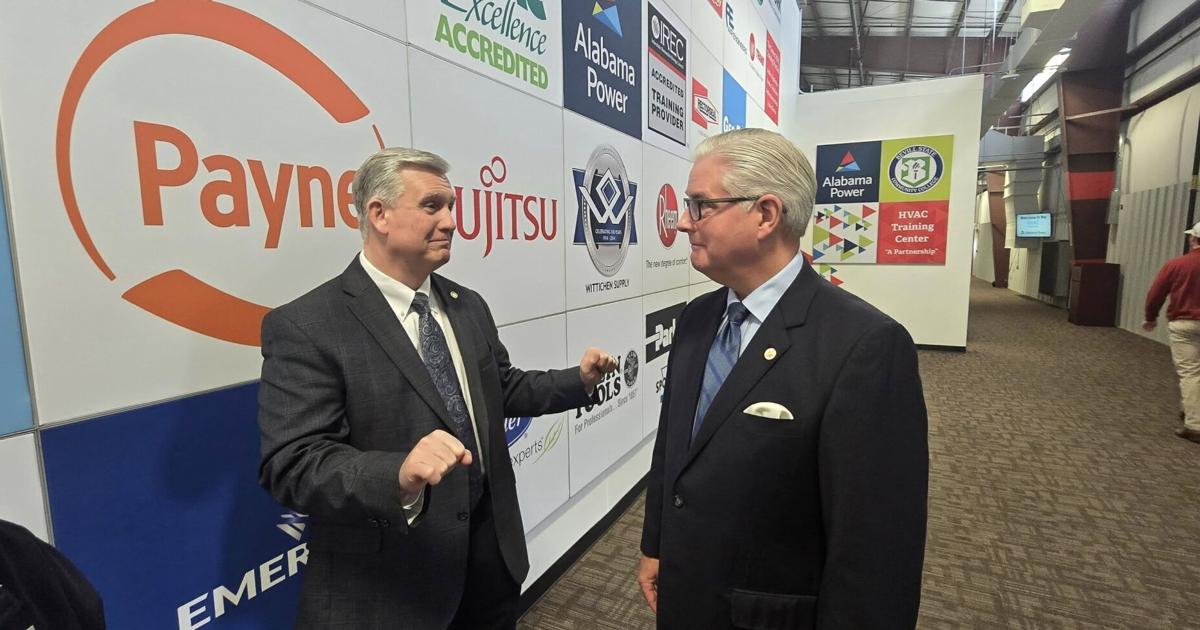
Alabama Secretary of Workforce Greg Reed, right, and Bevill State Community College President Joel Hagood share a light moment during a visit Reed made to address Leadership Walker County. Reed wants to work on providing education and training for the future workforce in Alabama.
He said the agency also wants to work with career tech education. He referenced the Heman Drummond Center of Innovation (HDCI) in Jasper as an “over-the-moon commitment to career education in Walker County.
Reed said Alabama already has 517 different entities at Workforce that house apprenticeship programs in many different fields of work, from food service to trucking. Recently, the department started the Youth in Apprenticeship program. Also, he mentioned the Growth in Youth Apprenticeship program has been started, noting businesses can’t hire 16 or 17-year-old children in factories because of child labor laws, which Workforce enforces.
“I got all the inspectors together and all the lawyers together, and I said, ‘Let’s figure this out. How can we offer these kinds of apprenticeship opportunities to kids, to give them the kind of skill sets that they are looking for to go along with their career tech education program?’ We’ve been able to figure that out in the way those programs can operate,” Reed said.
He said “very specific controls” are in place, but the program allows the teenager to get experience and be paid on the job to learn. “Then you’ve got a future employer who is anxious to help train and hopefully hire the child when they graduate from high school,” he said.
He noted the Legislature appropriated $100 million in the 2024 Regular Session for capital growth in career tech education facilities, with Walker County receiving “millions and millions of dollars to go along with the philanthropic gifts for the Heman Drummond Center of Innovation. That happened in multiple other places in Alabama.”
He also noted the rollout now taking place of the Career Pathways Diploma, which can be designated in the ninth grade if the student wants a career tech trade like a machinist. They move on a tract to get career tech instruction, possibly with assistance from the youth apprenticeship program. Then they are credentialed and get a dual enrollment scholarship with their local junior college in their senior year. At graduation, they get a Career Pathways Diploma and credentials for their career tech skill from the community college that will allow them to immediately go to work, he said.
He said the HDCI is expected to be a model for career center growth and how they can be structured.
Reed noted that nursing and accounting in Alabama are areas that have major deficits of workers. Statewide, on average, in rural areas, only 25 percent of students after high school graduation are getting four-year degrees. In urban areas, 45 percent have a four-year degree. He emphasized the department wants to support those still getting four-year degrees, but it also wants to see how it can support the majority who are not, so they have skills to work.
He even noted efforts at talking about the importance of work and why it should be celebrated are being carried out at school programs as early as the fourth grade. Many students have to be shown all the opportunities available to them, he said. Career coaches will be introduced more in the schools to help students understand work and training opportunities available to them.


Alabama Workforce Secretary Greg Reed, at the head of the table, addresses staff after being sworn in as secretary of the new Department of Workforce in February.
“We’re doing a lot better at that,” Reed said. “There is a lot more work to be done, and I think much of the collaboration with Workforce in the two-year system, the K-12 system and the 12-year system is going to be an effort moving forward to have collaboration to be able to do that.”
He also talked of the importance of finding ways adults can “earn and learn” in apprentice programs to get skill sets for higher-earning jobs. Programs to help already exist, he said, and he talked of the need to identify people who tried to start some educational effort in their youth who did not finish, and then encourage them to finish.
Asked what keeps him up at night with challenges, he noted how people complain about how hard it is to get people to work. “In the 10 months of doing this, I would say that is true in some ways, of course.” But he said many people don’t understand or know the opportunities and, in fact, don’t understand how to engage — and that he is kept up at night by the shortage of collaborations in helping those not in the workforce know what their opportunities are.
“I’ve had conversations with young people that work was not modeled in their life as a child. No one got up and went to a job, and were workers all day and made a salary or made a living,” he said. “A lot of those kinds of things, we need to do a better job of that. There are things schools are doing and will continue to do … that maybe in some ways we would think would be accomplished at home, but not in every home is it accomplished. We must have those young people think work is a good thing, a career is a noble opportunity and that they understand what is available and what skill sets that they can attain, they can do it. When they accomplish that and they wind up as a plumber and are working for $140 an hour, I mean, they can do this.”
He asked an AFL-CIO official if they would be willing to talk to students and parents about what they do as, say, a welder or boiler maker and they they make good salaries for doing that. “There are a lot of young people who don’t know those opportunities are available,” he said.
Millions of dollars of scholarships for Alabama students that are never applied for, Reed said. He has worked with Ivey and other organizations to develop a single application process so high school students can apply for college with a single free application that goes to every community college in the state and 14 four-year colleges and universities. The two-year colleges can then recruit those students and tell them of available scholarship opportunities to learn careers and skills.
As for possible legislation in the future, Reed touched on ongoing funding needs for dual enrollment and career tech. He said legislation could possibly help in funding more career tech instructors in schools, with schools paying stipends or bonuses to those instructors, much like football coaches are paid.
He also noted manufacturers have talked with him about a set of loaned executives, such as those used by United Way, who might take turns for a month to be instructors for young people, but still working for their companies. He said companies might even get tax breaks for offering that service. Also, local career tech workers, such as welders, might serve as aides to existing instructors, who get tax breaks and possibly future workers.
Reed also noted that healthcare workers are the biggest workforce deficit in all categories. Nursing educators are also the most needed. He talked of the need to find ways to recruit nursing practitioners to help teach in the schools.
link