Impact of pre-service education on the effectiveness of in-service training for inclusive preschool teachers in China: a potential profile analysis
The institutionalization process of inclusive education commenced with the 1994 Salamanca Statement, which established the fundamental principle of constructing an educational ecosystem responsive to learner diversity (Brown et al., 2013), thereby initiating a paradigm shift in educational placement for children with special needs (Rodriguez Fuentes et al., 2021). Under the guidance of sustainable development principles, international discourse has recently prioritized inclusive education. UNESCO’s Education 2030 Framework for Action (2015) emphasized equitable access to quality early childhood development for all children, providing a critical reference for advancing global inclusive preschool education. In 2021, UNESCO further delineated practical pathways through its report Inclusive Early Childhood Care and Education: From Commitment to Action, which serves as a strategic blueprint for national policymaking and implementation. This document has emerged as a policy action guide for enhancing inclusive preschool education worldwide (Deng et al., 2024).
In the process of policy implementation, inclusive preschool education has demonstrated distinctive practical characteristics. Compared to other educational stages, inclusive education for children aged 3–6 places greater emphasis on developmental support for individuals (Warren et al., 2016). Empirical evidence demonstrates that placing children with special needs in mainstream preschools not only enhances their social adaptability through early intervention (Dessemontet et al., 2012) but also constructs an initial framework for inclusive social cognition (Rodríguez-Oramas et al., 2021; Wang et al., 2025). This bidirectional benefit mechanism positions preschool education as a force multiplier for inclusion, yet simultaneously elevates demands on educators’ professional competencies. Effective implementation requires practitioners skilled in special needs assessment, differentiated instructional design, and inclusive environment creation (Majoko, 2019).
The study
Despite global institutional advancements in preschool inclusive education frameworks, implementation barriers persist. UNESCO’s Global Education Monitoring Report (2020) identified systemic disjunctions in teacher training systems as a critical bottleneck: pre-service programs emphasize theoretical paradigms, while in-service training prioritizes operational skills, lacking coherent integration. This fragmentation contradicts the demands of preschool inclusive education: educators must internalize both the ethical value of inclusive education and the practical wisdom to respond dynamically to the differences in children’s development. Existing studies predominantly adopt variable-centered approaches to analyze interactions among pre-service preparation, in-service training, and other factors (Clipa et al., 2019; Opoku et al., 2021). While valuable, such methodologies overlook individual heterogeneity and fail to capture trajectories of professional development. This study introduces latent profile analysis (LPA), an individual-centered statistical technique that emphasizes acknowledging intragroup differences and identifies shared variations across variables, enabling an in-depth analysis of subgroup characteristics (Wang and Hanges, 2011).
Building on this theoretical foundation, the study employs LPA to explore the classification of in-service training effectiveness among inclusive preschool teachers, while investigating dynamic interactions between pre-service education and in-service training effectiveness. It addresses two research questions:
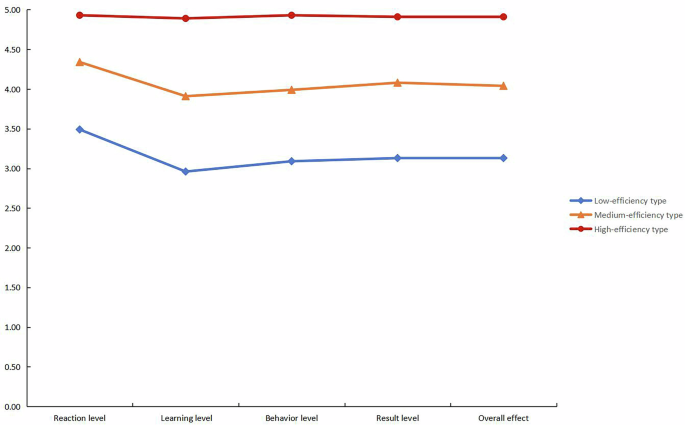
Research Inquiry 1: Based on LPA, into how many categories can the in-service training effectiveness of inclusive preschool teachers be classified? What are the defining characteristics of each category?
Research Inquiry 2: How do aspects of pre-service education, such as curriculum design, pedagogical mentorship, and experiential learning opportunities, influence the efficacy of in-service training programs for these educators?
Literature review
Pre-service education of inclusive preschool teachers
Pre-service education, a vital prerequisite for successful inclusive practices (Aldabas, 2020), involves the training and learning phase before university students transition to teaching roles (De Haro Rodríguez et al., 2019), emphasizing the acquisition of essential skills and knowledge for inclusive educational practices. Current trends indicate that talent development institutions are actively incorporating inclusive attitudes, knowledge, and skills into their curricula, emphasizing the cultivation of positive attitudes toward children with special needs among prospective teachers (Dignath et al., 2022; Koliqi et al., 2023). In terms of knowledge, the curriculum for pre-service education of inclusive preschool educators covers conceptual frameworks, policies, and child developmental characteristics. Regarding skills, universities prioritize teaching practical competencies like classroom management (Majoko, 2017a), collaborative methodologies (Allday et al., 2013), and family communication (Flecha and Soler, 2013). In terms of implementation format, personnel development includes practical facilities and partnerships, enabling educators to meet diverse demands in inclusive settings (Kwon et al., 2017) and apply knowledge in effective pedagogy (Hassanein et al., 2021). Simultaneously, the abundant resources and conducive conditions offered by pre-service education institutions facilitate prospective teachers in enhancing their professional development through creating inclusive classroom environments, effective teaching strategies, quality course materials, and mastering various techniques and technologies (Zabeli and Gjelaj, 2020). Nonetheless, while many educators exhibit favorable attitudes, their inability to impart effective instruction may undermine self-efficacy in inclusive education (Hu et al., 2016). Consequently, improvements in pre-service education are necessary to address these gaps and enhance the preparation of inclusive preschool educators.
In-service training of inclusive preschool teachers
In-service training, a critical avenue for teachers’ professional growth and lifelong learning, involves educators engaging in organized studies like seminars, courses, and expert teaching guidance to enhance their career-related knowledge and skills. In-service training programs play a crucial role in enhancing the pedagogical capabilities of preschool educators and fostering inclusive education attitudes. These programs provide teachers with extensive foundational knowledge, instructional techniques, and pedagogical strategies, enabling them to establish a robust educational framework aligned with inclusive principles, thereby facilitating the implementation of high-quality inclusive education practices (Kurniawati et al., 2017; Valle-Flórez et al., 2022). Empirical research highlights the importance of such training in shaping teachers’ self-efficacy and positive orientation towards inclusive education, with a significant correlation observed between training receipt and the development of these attributes (Štemberger and Kiswarday, 2018; Zabeli and Gjelaj, 2020). These training programs are predictive and offer vital support for the evolution of inclusive education-related attitudes and self-efficacy (Kisbu-Sakarya and Doenyas, 2021; You et al., 2019).
Nonetheless, an extensive examination of the global landscape of inclusive education reveals a concerning trend: studies consistently highlight the scarcity of substantive and effective in-service training opportunities for preschool educators (Ginja and Chen, 2023; Scanlon et al., 2022). Studies indicate that preschool inclusive education teachers generally receive little or no professional training in educating children with special needs (Chu, 2021). Issues facing the training of these teachers include inadequate support from educational administrations (Gonzalez-Gil et al., 2019) and a lack of diversity in training approaches (Ackah-Jnr, 2020). This not only limits the effective allocation of training resources but also undermines the training’s impact, hindering teachers’ substantial growth and improvement. Moreover, the majority of in-service training focuses on improving the overall quality and competence of the teaching force, often adopting a “large class size teaching” approach (Westbrook and Croft, 2015), which lacks personalized analysis and fails to meet individual teachers’ needs (Sharma and Jacobs, 2016). Nearly half of preschool inclusive teachers who had in-service training consider the training ineffective and struggle to apply the knowledge in their inclusive education practice, affecting their self-identification with their competence (Agbenyega and Klibthong, 2014). This inadequate training has emerged as a significant barrier to enhancing the quality of preschool inclusive education (Hernández-González et al., 2022; Tristani and Bassett‐Gunter, 2020). Therefore, in-service training, designed to perpetuate the culture of lifelong learning, is imperative. It can continue the learning outcomes achieved in the pre-service stage and support the sustainable development of early childhood educators’ abilities.
Ingration of pre-service education and in-service training of inclusive preschool teachers
Teacher professional development is not a one-time intervention but a sustainable process encompassing pre-service and in-service stages (Sun and Feng, 2024). According to teacher professional development theories (Zhu, 2014), constructing an integrated mechanism for pre-service and in-service training of inclusive preschool teachers helps overcome stage fragmentation, ensuring that inclusive education principles permeate teachers’ careers and better equipping them to address challenges in future teaching practices. Empirical evidence suggests that the integration of pre-service and in-service professional development has become a mainstream trend in teacher education, facilitating the transformation and transfer of theoretical knowledge into practical contexts, thereby enhancing teaching competence and educational quality (Zhou and Wang, 2024). Guided by modern lifelong education principles, teacher education in Guangdong, China, has shifted from a pre-service-focused model to an integrated pre-service and in-service system, gradually forming a comprehensive, continuous, and open teacher education framework (Wang and Xiu, 2024). Similarly, the United Kingdom has established a lifelong education system for teachers by providing proactive induction support and continuous in-service training for primary and secondary school teachers (Sun and Feng, 2024).
However, due to the relatively recent development of inclusive preschool education, an integrated professional development mechanism for inclusive preschool teachers has yet to be established. Existing research primarily focuses on specific stages, such as pre-service teachers’ attitudes toward inclusive education or in-service training support for inclusive preschool teachers (Wray et al., 2022). Few studies have explored the relationship between pre-service and in-service stages from an integrative perspective. This lack of integration may lead to fragmentation in the teacher training system, ultimately hindering the effective improvement of inclusive education quality.
link