
How Chrysler built the HEMI into an American icon

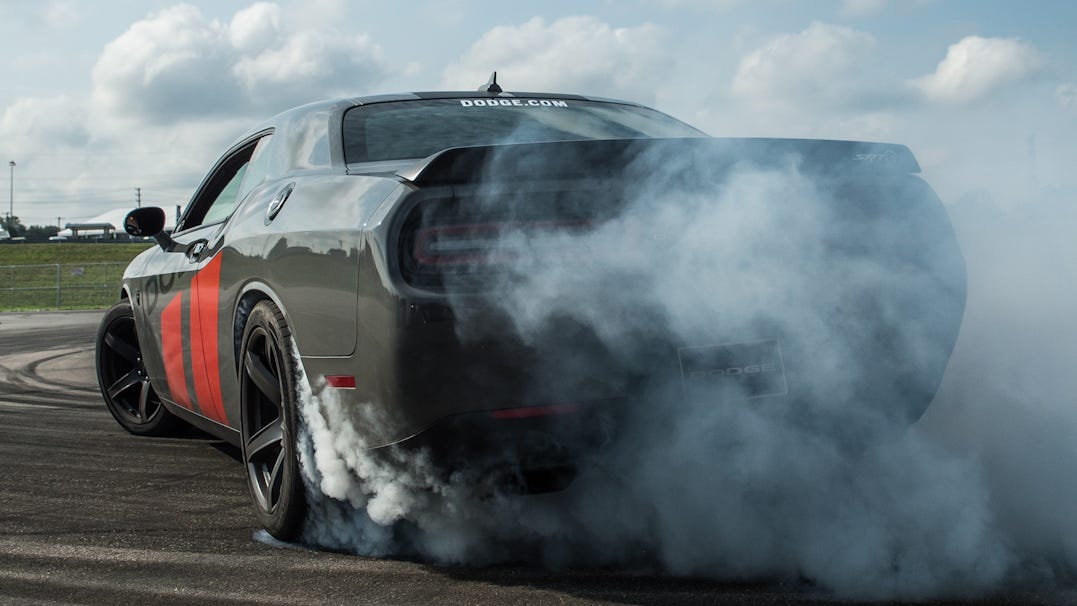

A look at the historic Hemi engine and how it has evolved
Chrysler’s first Hemi engine dates back to 1951 and is now enjoying a revival across Stellantis’ lineup.
- The HEMI engine is named after the engine’s hemispherical shaped piston heads.
- While Chrysler brands popularized and trademarked the name, HEMI-style engines were developed in the early 1900s.
- The HEMI has been through several generations, in a slew of different cars since it first appeared on the automotive scene in 1951.
If you’re at a Ram dealership and asking, “That thang got a HEMI?” odds are, that thang does. A year ago, that likely wasn’t the case.
The sub-brands of Stellantis — formerly the Chrysler Corporation, including nameplates like Dodge, Jeep, Fiat and Ram — have spent 2025 emphasizing the HEMI, returning the long-storied V-8 engine to its 1500 light-duty truck class, as well as making the HEMI standard on all Dodge Durangos, the company’s hallmark large SUV. Even Jeep has hinted at more HEMI availability among its offerings, including the Gladiator, Jeep’s pickup truck.
The HEMI’s current home is beneath the hoods of a few of Stellantis’ largest, most powerful offerings, but the engine has anchored some of the most iconic vehicles in Chrysler history. As Ram celebrates a return to the HEMI, a look back at the life of the motor shows it has gone through several generations, cancellations, updates and revivals from 1951 to 2025. This is how the HEMI has changed through time, according to a trove of internet archives, vintage brochures and other automotive history.
But first, a very brief lesson in engineering.
What makes a HEMI a HEMI?
The name HEMI comes from the hemispherical (meaning half circle) piston heads used in the eponymous engines. The rounded piston heads, slotted into a rounded chamber to match, offered higher efficiency with less energy lost to heat while fuel is combusted before being sent out as exhaust.
The Chrysler Corporation, of course, popularized and trademarked the name, but plenty of automakers have used hemispherical combustion chambers in their engines. In fact, one of the earliest versions of an engine with the hemispherical piston heads came from a different Michigan automaker — and it wasn’t Ford or Chevy.
It was Welch, a short-lived automaker based in Pontiac, that used the technology to power its 1908 Model 4-L, which put out a whopping 50 horsepower in an age when some cars on the road offered fractions of one horsepower. Many automakers toyed around with hemispherical piston designs in the early 20th century, including Chrysler’s recently adopted siblings Alfa Romeo, Fiat and Peugeot.
First generation: 1951 FirePower V-8
Chrysler’s HEMI technology was first used by the company to power the XIV-2220, a V16 fighter jet engine that it developed at the tail end of World War II. The engine never saw wartime use, but Chrysler engineers returned to a postwar America with some ideas about how to make powerful, efficient engines with a hemispherical combustion chamber.
Chrysler’s first mass-produced HEMI, introduced in 1951 and inspired by the work done on the fighter jet, was called the FirePower.
The powerful V-8 engine was used to power the Chrysler New Yorkers, Imperials and Saratogas of the 1950s. At 331 cubic inches and 180 horsepower, the engine brought significant thrust to Chrysler’s mainstream offerings, outclassing most of its competition.
Dodge adapted the FirePower to the 1953 Red Ram pickup truck, and Desoto, a now-defunct Chrysler imprint, also began using the engine, calling it the Firedome.
The FirePower engine was seen as both a powerful daily driver and a weekend racer as street racing culture developed.
By the mid-50s, Chrysler beefed up the 331 cubic inch engines into 392 cubic inch V-8s, stuffing them beneath the hoods of New Yorkers and Imperials.
By 1958, though, as automotive regulators became concerned with large car brands’ associations with racing, the FirePower engine was discontinued.
Second generation: 1964 426 HEMI
For older gearheads, the 426 cubic inch HEMI, first produced in 1964, ranks among the greatest engines of all time.
It began as a racing engine, limited only to NASCAR, and it powered Richard Petty’s Plymouth Belvidere on the NASCAR circuit when he won his first of seven Daytona 500s. The 426 race HEMI was so powerful that other race teams begged NASCAR to ban the engine.
By 1965, a slightly tuned down 426 became publicly available as the “HEMI street engine,” powering late 60s street racing machines like the Dodge Coronet, Plymouth Belvidere, Plymouth Satellite, Plymouth Barracuda and the legendary Dodge Charger.
The 426 street HEMI, loud and grumbling, offered 425 horsepower to the public while the more robust 426 race HEMI tore up NASCAR and National Hot Rod Associations into the early 70s, until stricter emissions regulations stalled the HEMI from mass production.
Chrysler halted production of the 426 HEMI in 1971 and did not market its cars using the HEMI name for another 10 years, when a few of Chrysler’s small, less powerful K-cars ran on a Mitsubishi-produced 2.6L four-cylinder engine that used hemispherical piston head technology.
Though those vehicles, like the Dodge Aries and Plymouth Reliant, were sales successes — often referred to as the cars that saved Chrysler’s bacon — they were a stark departure from the HEMIs of the 70s. The HEMI designation was largely a marketing tool, as the tiny, outsourced engines eked out only 96 horsepower.
Third generation: The HEMI revival
After 16 years of dormancy, the third generation of the HEMI engine debuted in the 2003 model year as the Ram 1500’s new powertrain.
It was a hit.
Ram pickups with a HEMI became a cultural touchpoint via the clever “That thang got a HEMI?” advertising campaign. The trucks were powered by a redesigned 5.7L HEMI V-8 that produced 345 horsepower.
The third-generation engine carried all the name and the bravado of HEMI, without the HEMI technology. The current HEMI no longer uses a proper hemispherical piston head design, instead using flattened piston heads that are more efficient and less emissive.
After the revival of the HEMI in 2003, Chrysler-affiliated brands slowly began a HEMI bonanza. In 2005, the company launched the HEMI SRT-8 with 425 horsepower, matching the output of the legendary second-generation engine. Soon after, a 392 cubic inch HEMI gave customers 470 horsepower off the lot.
Third-generation HEMIs of some sort have appeared in Chrysler 300s, Dodge Magnums, Chargers, Challengers, Durangos, Jeep Grand Cherokees and the Gladiator.
And in 2015, Dodge launched the first HEMI engine without natural aspiration: The 707-horsepower supercharged Hellcat engine. Dodge followed the Hellcat up with the more powerful Demon, and a massive, 1000-horsepower crate engine dubbed the Hellephant.
In 2024, Ram announced it would be slowing production of the HEMI engine in its 1500-series pickup trucks, but the change lasted only for a year before the company ran a frenzied engineering campaign to retool the 5.7L version of the engine for the 2026 model year.
Outside of the Sterling Heights Assembly Plant, where Ram Trucks are made, a large black and yellow banner hangs with a loud and proud message:
“The HEMI V-8 is back.”
Liam Rappleye covers Stellantis and the UAW. Contact him: [email protected].
link