
Critical factors analysis of student-athletes learning training contradiction via AHP
Participant characteristics
The demographic profile of the 14 Delphi experts is presented in Table 1. Key characteristics reveal a strategically sampled cohort:
-
(1)
Institutional Representation: Universities: 9 experts (64.3%); Secondary schools: 3 experts (21.4%); Elementary schools: 2 experts (14.3%).
-
(2)
Gender Distribution: Male: 7 (50.0%); Female: 7 (50.0%).
-
(3)
Experience Profile: All participants had ≥ 5 years of professional experience (M = 11.3 years, SD = 4.2) Academic Seniority: Full Professors: 35.7% (n = 5); Associate Professors: 35.7% (n = 5); Senior Lecturers: 28.6% (n = 4).
-
(4)
Age Range: All participants were ≥ 30 years (M = 42.6, SD = 6.8; range: 32–58 years).
Analysis results of the Delphi method
Indicator selection
The China National Knowledge Infrastructure (CNKI) database was searched for Chinese literature (1990/01/01–2024/11/01) using “Learning Training Contradiction” (LTC) in titles/abstracts/keywords. Web of Science Core Collection was searched for English literature using “learning and training contradiction” (1900–2024, article type, English language). Additional sources included Google Scholar, Sci-Hub, and PubMed. Retrieval yielded 279 Chinese and 582 English publications (Tables 2 and 3).
Initial factors influencing long-term care (LTC) in student-athletes were identified through a review of literature and refined with input from experts via face-to-face, phone, and digital consultations. Four core categories emerged: Coach-related Factors, Student-related Factors, Management/Support Factors, and Family Environment Factors. This led to the development of a preliminary indicator system comprising 4 criterion-level indicators, 13 factor-level indicators, and 62 alternative-level indicators. Fourteen experts from universities and secondary schools evaluated these indicators using the Delphi method (Table 4).
Statistical analysis and methods
-
(1)
Expert Positive Coefficient (Response Rate).
The response rate reflects experts’ engagement level. Higher rates indicate greater reliability. This study achieved:
Round 1: 14/14 questionnaires returned (100%).
Round 2: 14/14 questionnaires returned (100%).
This confirms high expert commitment and data reliability.
-
(2)
Expert Opinion Concentration.
Expert opinion concentration is quantified using the Arithmetic Mean (Mj) and Full-Score Frequency (Kj).
-
A.
Arithmetic Mean.
The importance of indicator “j” is measured by its arithmetic mean, calculated as
$$M_{{\text{j}}} = \frac{1}{{{\text{n}}_{{\text{j}}} }}\sum\nolimits _{{i = 1}}^{n} C_{{{\text{ij}}}}$$
Mj represents the number of experts evaluating indicator “j”, Cij represents the score assigned to indicator “j” by expert “i”. A higher Mj value indicates greater perceived importance of indicator “j” by the expert panel.
-
B.
Full-Score Frequency.
The consensus on critical importance is assessed by
$$\mathop K\nolimits_{j} =\frac{{\mathop {\text{n}}\nolimits_{{\text{j}}} }}{{\mathop {\text{m}}\nolimits_{j} }} \times 100\%$$
mj represents the number of experts evaluating indicator “j”, nj represents the number of experts assigning the maximum score to indicator “j”. Higher Kj values reflect stronger expert consensus on the essentiality of indicator “j”.
Table 5 (presented in subsequent sections) details the ranges of Mj and Kj cross all hierarchical levels based on the two Delphi rounds.
-
(3)
Consensus Level of Expert Opinions.
Expert consensus was assessed using the Coefficient of Variation (Lj) and Coefficient of Concordance (χ²).
A. Coefficient of Variation
$$\mathop M\nolimits_{j} =\frac{1}{{\mathop {\text{n}}\nolimits_{j} }}\mathop{\sum}\nolimits_{{i=1}}^{{\text{n}}} \mathop C\nolimits_{{ij}}$$
$$\mathop S\nolimits_{j} =\sqrt {\frac{1}{n}\sum\nolimits_{{i=1}}^{n} {\mathop {\left( {\mathop C\nolimits_{{{\text{ij}}}} – \mathop M\nolimits_{{\text{j}}} } \right)}\nolimits^{2} } }$$
$$\mathop L\nolimits_{j} =\mathop S\nolimits_{j} \mathop {/M}\nolimits_{{\text{j}}}$$
nj represents the number of experts rating indicator j, Cij represents the score assigned by expert i to indicator j, Mj represents the arithmetic mean of indicator j, Sj represents the population standard deviation of indicator j, Lj represents the coefficient of variation of indicator.Lower Lj values indicate higher consensus for indicator j (Lj< 0.15 typically denotes strong agreement) (Table 6).
$$W=\frac{{\sum\nolimits_{{j=1}}^{n} {d_{j}^{2}} }}{{\sum\nolimits_{{j=1}}^{n} {d_{j}^{2}(\hbox{max} )} }}$$
Where:
$$\sum\limits_{{j=1}}^{n} {d_{j}^{2}} =\sum\limits_{{j=1}}^{n} {{{({R_j} – \overline {R} )}^2}} {\text{(Sum of squared rank deviations)}}$$
$$\sum\limits_{{j=1}}^{n} {d_{j}^{2}} (\hbox{max} )=\frac{1}{{12}}{m^2}({n^3} – n) {\text{(Maximum possible sum of squared deviations)}}$$
When adjusting for tied ranks:
$$W=\frac{{12\sum\nolimits_{{j=1}}^{n} {d_{j}^{2}} }}{{{m^2}({n^3} – n) – m\sum\nolimits_{{i=1}}^{m} {{T_i}} }}$$
\(m\) represents the number of experts, \(n\) represents the number of indicators, R j represents the sum of ranks assigned to indicator j, \(\:\stackrel{-}{R}\) is the mean of rank sums\(\left( {\frac{{\sum\nolimits_{{j=1}}^{n} {{R_j}} }}{n}} \right)\), T i represents the correction factor for tied ranks in expert i’s ratings, computed as \({T_i}=\sum\nolimits_{{k=1}}^{g} {(t_{k}^{3} – {t_k})}\), where g is the number of tied groups and t k is the size of the k-th tied group.Ti is the tied ranks correction for expert i. \(W\) ranges from 0 (no agreement) to 1 (complete agreement). Higher values indicate stronger consensus. After 2–3 consultation rounds, \(W\) typically stabilizes below 0.5 with controlled error margins.
C. Significance Testing of Concordance (χ² Test).
\(m\) represents the number of experts, \(n\) represents the number of indicators, \(W\) is Kendall’s coefficient of concordance
The degrees of freedom are calculated using the formula: \(df=n – 1\)
If p < 0.05, it indicates that experts are in the significant concordance and results are statistically acceptable; if p ≥ 0.05, it indicates that experts are in the non-significant concordance and results require re-evaluation.
The consensus analysis reveals (Table 7):
Round 1: Moderate agreement (W = 0.399, χ² (78) = 435.397, p<0.001)
Round 2: Enhanced consensus (W = 0.448, χ² (70) = 439.151, p<0.001), approaching the strong agreement threshold (W≥ 0.5).
Conclusion: Both rounds exhibited statistically significant consensus (p< 0.001), confirming the reliability of expert judgments at 95% confidence.
-
(4)
Expert Authority Assessment.
The authority coefficient (Cr) of experts is determined by their judgment basis (Cα) and familiarity level with the indicators (Cs).
A. Expert Authority Coefficient.
$${C_r}=\frac{{({C_\alpha }+{C_{\text{s}}})}}{2}$$
Cα reflected judgment basis (practical/theoretical/contextual experience) per Table 8, Cs measured subject familiarity per Table 8. Judgment Basis(Cα) derives from four dimensions: Practical experience, Theoretical analysis, Knowledge of domestic/international practices and Intuition. The coefficient (Cα) is the sum of all selected judgment basis values for an expert, with(Cα) ≤ 1. When Cα = 1, the judgment basis has a significant influence on the expert; when Cα = 0.8, the influence is moderate; when Cα = 0.6, the influence is relatively small. The judgment basis is shown in Table 8.
The self-evaluated expert authority demonstrated robust methodological rigor across both consultation rounds (Tables 8 and 9): Judgment Basis Coefficient (\(Ca\)) increased from 0.82 (Round 1) to 0.85 (Round 2), indicating major influence of expertise (threshold: > 0.80). This reflects experts’ substantial reliance on practical experience, theoretical analysis, and contextual knowledge during evaluation. Familiarity Level (\(Cs\)) rose from 0.70 to 0.74, confirming moderate-to-strong subject-matter competence (classification: 0.60–0.80 = “relatively familiar” to “very familiar”). Authority Coefficient (\(Cr\)) exceeded the 0.75 high-reliability threshold in both rounds (Round 1: 0.76; Round 2: 0.80), validating the content validity of consultation outcomes70. The 5.3% inter-round improvement signifies enhanced engagement consistency. Sustained high authority coefficients (\(Cr\)> 0.75) confirm that expert judgments were anchored in substantive domain knowledge and experiential reasoning, mitigating subjective bias risks inherent in Delphi techniques (Table 10).
Model modification and refinement
This study implemented a two-round Delphi expert consultation process to refine the evaluation indicators, primarily utilizing the critical threshold method for indicator screening. For each candidate indicator, three statistical measures were calculated: full-score frequency (Kj), the arithmetic mean (M), and the coefficient of variation (CV). The critical thresholds for retention were determined through specific statistical operations. Indicators scoring above the threshold defined as the mean minus the standard deviation (M – SD) were retained for both full-scores frequency and the arithmetic mean. Conversely, for the coefficient of variation, indicators scoring below the threshold calculated as the mean plus the standard deviation (M + SD) were retained. Comprehensive computational outcomes for these criteria are detailed in Tables 11 and 12. To safeguard against the inadvertent exclusion of pivotal indicators, a conservative elimination protocol was adopted: only indicators failing to satisfy all three screening criteria simultaneously were removed. Those failing one or two criteria underwent thorough deliberation by the research team, with decisions regarding their retention or removal grounded in the fundamental principles of comprehensiveness, scientific validity, and operational feasibility. Throughout this iterative refinement process, substantive consideration was consistently given to all modification suggestions and qualitative feedback provided by the expert panel, ensuring the model’s robustness and contextual relevance.
Following the initial round of expert consultation, eight indicators were eliminated based on the critical threshold principle: “Physical Fitness Research (D114)”, “Technical/Tactical Research (D115)”, “Training Foundation (D221)”, “Physical Fitness Level (D222)”, “Technical/Tactical Level (D223)”, “Credit Management (D314)”, “Management by Physical Education Departments (D315)”, and “Family Member Circumstances (D424)”. These indicators failed to meet the critical thresholds for all three criteria: frequency of full scores, arithmetic mean, and coefficient of variation. Additionally, the expert panel suggested conceptual overlaps: D114 and D115 with indicators D111, D112, D113, and D242 with D422, further justifying their removal. Indicators “Student Investment in Training (D232)” and “Student Investment in Academic Studies (D234)” fell below the thresholds for arithmetic mean and frequency of full scores. Considering that “Student Attitude Towards Training (D231)” encompassed the content of D232 and “Student Attitude Towards Academic Learning (D233)” encompassed D234, both D231 and D233 were subsequently deleted. The first-round consultation also identified problematic indicator phrasing. “Cultural Knowledge Level (C24)” and “Teacher”s Instructional Plan (D341)” were deemed inappropriate, while “Whether Special Tutoring Teachers Are Arranged (D316)” was considered ambiguous. Through discussion with the panel, these were revised to “Academic Proficiency Level (C24)”, “Academic Subject Instructional Plan (D351)”, and “Whether Dedicated Academic Subject Tutoring Teachers Are Arranged (D321),” respectively. Experts further indicated that indicators D125 and D126 were misplaced under “Coaching Motivation (C13)”, and D311 and D312 were inappropriate under “Management System (C31)”, recommending the creation of new sub-factor level indicators. Subsequent analysis, incorporating this feedback, led to the addition of “Academic-Athletic Cognition (C14)” under “Coach Factors (B1)” and “Leadership Attitude (C31)” under “Management and Support Factors (B3)”. This comprehensive revision reduced the total number of indicators from 79 to 71. A revised questionnaire and detailed modification notes were sent to the original 14 experts. Analysis of the second-round responses revealed no indicators falling outside the critical thresholds across all three criteria, and no indicators prompted significant controversy or new suggestions for additions. Consequently, a refined evaluation indicator system was finalized, as presented in Table 13.
AHP analysis results
Step 1: Constructing the decision hierarchy model for the LTC
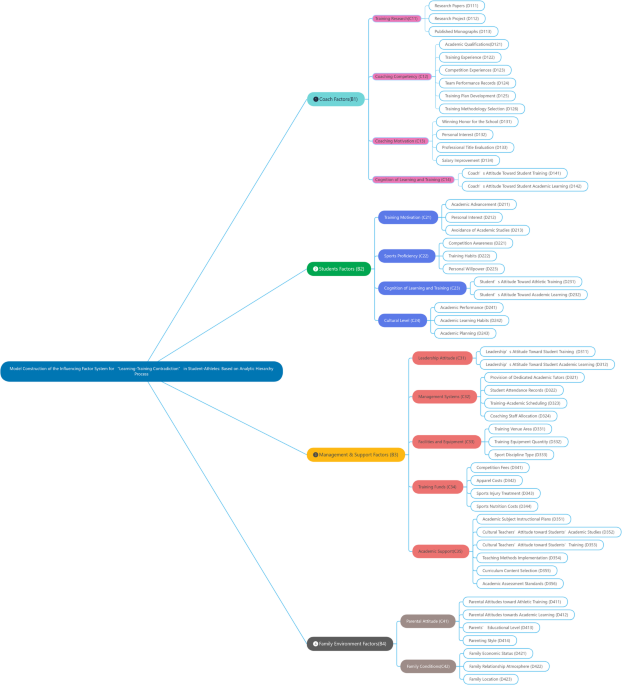
To identify factors exhibiting greater relative importance within the LTC, the initial phase involves establishing a hierarchical relationship among influencing elements. Figure 1 presents the hierarchical model developed in this study, comprising four criterion layers (B1-B4), fifteen factor layers (C11-C42), and fifty-two indicator layers (D111-D423) across four hierarchical tiers.

Hierarchical model of factors influencing the LTC.
Step 2: Constructing pairwise comparison matrices
Following the establishment of the hierarchical structure, the subordination relationships between elements across adjacent levels are defined. The second step involves applying Saaty’s 9-point relative importance scale12 to perform pairwise comparisons. Indicators are compared in pairs within each hierarchical level to determine their relative importance concerning the superior criterion (Table 14). This study utilized YAAHP (Version number: 12.11.8293) to construct the judgment matrices. The process entailed generating a 5 × 5 matrix centered on the target layer (Level 1) through synthesis of pairwise comparison data and developing 3 × 3 matrices for secondary criteria under each primary criterion layer. The local weight vectors (eigenvectors) of these pairwise comparison matrices were computed to determine Local weights (relative priorities within each matrix) and Local priorities (relative influence of elements within their level). As established by Saaty15 these local priorities immediately quantify the relative impact of element sets within a given level through the pairwise comparison matrix sets.
Use Intermediate values when compromise is needed between adjacent scales 2, 4, 6, 8 and Reciprocals for inverse comparisons (\({a_i}\)vs.\({a_j}\))1/3, 1/5, 1/7, 1/9.
Step 3: Determining indicator weights and consistency validation
In AHP, calculating the Consistency Index (CI) and Consistency Ratio (CR) is essential. When assigning values to indicators, strict adherence to judgment matrix principles is required. To effectively prevent bias in matrix consistency, validation against the Random Consistency Index (RI) values (as detailed in Table 15) must be performed to verify logical consistency71. A CR value < 0.1 confirms acceptable consistency If CR ≥ 0.1, the judgment matrix must be adjusted iteratively until compliance is achieved The Consistency Ratio quantifies the deviation between decision-makers’ judgments and perfect consistency, calculated as: CR = CI/RI.
In this study, YAAHP (Version number: 12.11.8293) was employed to statistically analyze the judgment matrices at the criterion level and each indicator level to obtain the weight distribution and consistency test at the criterion level. From the results of the consistency test, the opinions of 14 experts in the relevant fields constituted the final sample of this study, and the CR value of the final sample was calculated by eliminating the inconsistent responses.
-
(1)
Consistency Index Formula:
$$CI=\frac{{{\lambda _{{\text{max}}}} – {\text{n}}}}{{{\text{n-}}1}}$$
Based on the derived consistency indicators, the consistency ratio was computed in accordance with the following formula:
-
(2)
Dynamic Adjustment Mechanism for Inconsistency.
The CR test fundamentally quantifies the logical self-consistency of expert judgments. When CR > 0.1, it indicates systematic bias or random errors in the judgment matrix, necessitating structured adjustments to achieve cognitive-data alignment.
1) Human-machine collaborative correction: By leveraging the real-time CR monitoring function of the YAAHP (Version number: 12.11.8293), identify the 3–5 elements that have the greatest impact on consistency. When the CR shows inconsistency, utilize its automatic correction function for inconsistent matrices. Under the premise of preserving the expert’s original data, optimize the judgment matrix through the genetic algorithm to ultimately ensure the consistency of the CR value.
2) Digital optimization processing: For matrices with mild inconsistency (0.1 < CR ≤ 0.2), apply the geometric mean correction method:
$$a_{{ij}}^{{new}} = \sqrt[n]{{\prod\nolimits_{{k = 1}}^{n} a_{{ik}} .a_{{kj}} }}$$
For the highly inconsistent matrix (CR > 0.2), the optimal transfer matrix method is introduced, and the modified matrix is solved by the least square method.
Based on the data analysis and organization in Table 16, the ranking of the weights of each level element in the criterion layer is as follows: B1 (Coach Factors, 0.5611) > B2 (Student Factors, 0.2613) > B3 (Management Support, 0.1067) > B4 (Family Environment, 0.0709). Coach Factors is the most significant contributor to the LTC. The Consistency Ratio (CR) is 0.0958, and the maximum eigenvalue is 4.2558.
Based on the data analysis and organization in Table 17, the ranking of the weights of each level element under the coach demension in the factor layer is as follows: C13 (Coaching Motivation, 0.5280) > C12 (Coaching Competency, 0.2014) > C11 (Training Research, 0.1595) > C14 (Academic-Athletic Cognition, 0.1111). Coaching Motivation is the most significant factor influencing the LTC. The CR is 0.0776, and the maximum eigenvalue is 4.2072.
Based on the data analysis and organization in Table 18, the ranking of the weights of each element under the student dimension in the factor hierarchy is as follows: C21 (Training Motivation, 0.5704) > C24 (Academic Proficiency, 0.1897) > C23 (Academic-Athletic Cognition, 0.1237) > C22 (Athletic Level, 0.1163). Training Motivation the most significant factor influencing the LTC. The CR is 0.0909, and the maximum eigenvalue is 4.2427.
Based on the data analysis and organization in Table 19, the ranking of the weights of each level element under the management support in the factor hierarchy is as follows: C32 (Management System, 0.3014) > C31 (Leadership Attitude, 0.2939) > C33 (Facilities/Equipment, 0.1971) > C34 (Training Funds, 0.1477) > C35 (Academic Support, 0.0599). Management System is the most significant factor influencing the LTC of student-athletes. The CR is 0.0847, and the maximum eigenvalue is 5.3795.
Based on the data analysis and organization in Table 20, C41 (Parental Attitude) and C42 (Household Conditions) equally contribute (0.5000 each). These two factors are equally significant in influencing the LTC of student-athletes under the family environment. The CR is 0, and the maximum eigenvalue is 2.
Based on the data analysis and organization in Table 21, the ranking of the weights of each level element under the training research in the index hierarchy is as follows: D111 (Research Papers, 0.6144) > D113 (Published Monographs, 0.2684) > D112 (Research Projects, 0.1172). Research Papers is the most significant factor influencing the LTC of student-athletes under the training research. The CR is 0.0707, and the maximum eigenvalue is 3.0735.
Based on the data analysis and organization in Table 22, the ranking of the weights of each level element underCoaching Competency in the index hierarchy is as follows: D126 (Training Methodology Selection, 0.4185) > D124 (Team Performance Records, 0.1996) > D125 (Training Plan Development, 0.1847). Training Methodology Selection is the most significant factor influencing the LTC. The CR is 0.0983, and the maximum eigenvalue is 6.6192.
Based on the data analysis and organization in Table 23, the ranking of the weights of each level element under the coaching motivation factor in the index hierarchy is as follows: D134(Salary Improvement, 0.5705) > D133(Professional Title Evaluation, 0.2305) > D132(Personal Interest, 0.1131) > D131(Winning Honor for the School, 0.0860). Salary Improvement is the most significant factor influencing the LTC of student-athletes. The CR is 0.0785, and the maximum eigenvalue is 4.2097.
Based on the data analysis and organization in Table 24, the ranking of the weights of each level element under the indicator hierarchy of the student’s training cognition factor is as follows: D142(Coaches’ attitudes toward student’ learning, 0.8333) > D141(Coaches’ attitudes toward student’ training, 0.1667). Coaches’ attitudes toward student’ learning is the most significant factor influencing the LTC of student-athletes. The CR is 0, and the maximum eigenvalue is 2.
Based on the data analysis and organization in Table 25, the ranking of the weights of each level element under the training motivation factor in the index hierarchy is as follows: D211(Promotion, 0.5396) > D213(Avoidance of study, 0.2970) > D212(Hobbies and interests, 0.1634). Promotion is the most significant factor influencing the LTC of student-athletes. The CR is 0.0088, and the maximum eigenvalue is 3.0092.
Based on the data analysis and organization in Table 26, the ranking of the weights of each level element under the factor of sports proficiency in the index hierarchy is as follows: D223(Personal willpower, 0.5499) > D222(Exercise habits, 0.2402) > D221(Match consciousness, 0.2098). Personal willpower is the most significant factor influencing the LTC of student-athletes. The CR is 0.0176, and the maximum eigenvalue is 3.0183.
Based on the data analysis and organization in Table 27, the ranking of the weights of each level element under the indicator hierarchy of “Cognition of learning and training” is as follows: D231(Students’ attitudes toward athletic training, 0.8000) > D232(Students’ attitudes towards cultural learning, 0.2000). Students’ attitudes toward athletic training is the most significant factor influencing the LTC of student-athletes. The CR is 0, and the maximum eigenvalue is 2.
Based on the data analysis and organization in Table 28, the ranking of the weights of each level element under the cultural level factor in the index hierarchy is as follows: D243(Cultural learning plannin, 0.4126) > D242(Cultural Study Habits, 0.3275) > D241(Cultural academic achievement, 0.2599). Cultural learning plannin is the most significant factor influencing the LTC of student-athletes. The CR is 0.0516, and the maximum eigenvalue is 3.0536.
Based on the data analysis and organization in Table 29, it is concluded that the ranking of the weights of each level element under the factor of leadership attitude in the index hierarchy is as follows: D311(Leaders’ attitude toward student training, 0.5000) = D312(Leaders’ attitudes toward student learning, 0.5000). These two factors are the most significant factor influencing the LTC of student-athletes. The CR is 0, and the maximum eigenvalue is 2.
Based on the data analysis and organization in Table 30, the ranking of the weights of each level element under the management systems factor in the index hierarchy is as follows: D324(Number of coaches, 0.5731) > D323(Scheduling of academic training, 0.2624) > D322(Student attendance, 0.1005) > D321(Whether a Dedicated Tutor for Academic Courses is Assigned, 0.0640). Number of coaches is the most significant factor influencing the LTC of student-athletes. The CR is 0.0360, and the maximum eigenvalue is 4.0961.
Based on the data analysis and organization in Table 31, the ranking of the weights of each level element under the factor of venue and equipment in the index hierarchy is as follows: D331(Area of training grounds, 0.5584) > D333(Types of sports programs, 0.3196) > D332(Number of training devices, 0.1220). Area of training grounds is the most significant factor influencing the LTC of student-athletes. The CR is 0.0176, and the maximum eigenvalue is 3.0183.
Based on the data analysis and organization in Table 32, the ranking of the weights of each level element under the training funds factor in the index hierarchy is as follows: D344 (Sports Nutrition Costs, 0.4468) > D342 (Apparel Costs, 0.2600) > D343 (Sports Injury Treatment Costs, 0.1939). Sports Nutrition Costs is the most significant factor influencing the LTC of student-athletes. The CR is 0.0495, and the maximum eigenvalue is 4.1323.
Based on the data analysis and organization in Table 33, the ranking of the weights of each level element under Academic Support in the index hierarchy is as follows: D353 (Cultural Teachers’ Attitude Toward Training, 0.3708) > D356 (Academic Assessment Standards, 0.1675) > D354 (Teaching Methods Implementation, 0.1377). Cultural Teachers’ Attitude Toward Training is the most significant factor influencing the LTC of student-athletes. The CR is 0.0990, and the maximum eigenvalue is 6.6235.
Based on the data analysis and organization in Table 34, the ranking of the weights of each level element under the factor of parents’ attitude in the index hierarchy is as follows: D411 (Parents’ Attitude Toward Training, 0.3682) > D413 (Parents’ Educational Level, 0.3216) > D414 (Parenting Style, 0.1949). Parents’ Attitude Toward Training is the most significant factor influencing the LTC of student-athletes. The CR is 0.0695, and the maximum eigenvalue is 4.1855.
Based on the data analysis and organization in Table 35, the ranking of the weights of each level element under the factor of household conditions in the index hierarchy is as follows: D421 (Family Economic Status, 0.4286) = D422 (Family Relationship Atmosphere, 0.4286) > D423 (Family Location, 0.1429). Family Economic Status and Family Relationship Atmosphere are the most significant factor influencing the LTC of student-athletes. The CR is 0, and the maximum eigenvalue is 3.
Step 4: Synthesis of global weight
-
(5)
Hierarchical total ordering is achieved by aggregating local priority weights across all levels, calculating the global importance weights of each element relative to the overarching goal. This synthesis proceeds top-down sequentially, where the single-level ordering of the second layer (directly below the goal) constitutes its total ordering48. This study computed Global Weight using YAAHP (Version number: 12.11.8293) synthesis module, with key results consolidated in Tables 36, 37 and 38.
The AHP revealed differential impacts of factors on student-athletes’ LTC (Table 36). Among the four core factors at the criterion level: Coach Factor (B1) was the most influential (weight = 0.5611), followed by Student Factor (B2) (0.2613), Management Support Factor (B3) (0.1067), And Family Environment Factor (B4) (0.0709). Notably, while Family Environment demonstrated the lowest weight (0.0709), it remains a non-negligible element due to its documented effects on student’ academic motivation and athletic engagement.
The AHP analysis demonstrated systematic prioritization across hierarchical levels (Tables 37 and 38). At the criterion level, coaching motivation (0.5280) constituted the paramount sub-factor under Coach Factor, substantially exceeding coaching competency (0.2014) and research-training transfer (0.1595), while academic-athletic perception (0.1111) ranked lowest. Within Student Factor, training motivation (0.5704) emerged as the dominant influence, followed distantly by academic-athletic perception (0.1897), academic proficiency (0.1437), and athletic level (0.1163). For Management Support, academic support (0.3014) and leadership attitude (0.2939) jointly outweighed funding (0.1971), management systems (0.1477), and facilities (0.0599). Notably, Family Environment exhibited bifurcated equivalence, with both parental attitude and family conditions at 0.5000. Globally, coaching motivation (0.2962) represented the most consequential driver of study-training conflict, underscoring coaches’ pedagogical influence on athlete development. This necessitates institutional emphasis on evidence-based coaching philosophies. Alternative-level analysis further revealed that: Research publications (0.6144) dominated research-training transfer, Training methodology selection (0.4185) prevailed in coaching competency, Critical sub-factors included professional title evaluation (coaching motivation: 0.5705), personal willpower (training motivation: 0.5499), and equipment quantity (facility management: 0.5584). Despite equivalent weights in leadership attitudes (0.5000 × 2) and family conditions (0.4286 × 2), their operational mechanisms diverged significantly. Synthesizing global weights identified eight core determinants, with coach-related elements occupying four positions: Coach factor (0.5611) Coaching motivation (0.2962, embedding title evaluation at 0.1690) Coaching competency (0.1150) Research-training transfer (0.0895). This hierarchy confirms that institutional interventions should prioritize coaching development, particularly through motivational enhancement and credential recognition systems.
link