


New York City can be everything to everyone, though it is not considered an automotive mecca. It wasn’t always this way. Long before anyone in the Big Apple even floated the idea of a toll to enter the city, New York was quick to embrace the automobile.
Along Manhattan’s boulevards, every major automaker once had a beautiful flagship showroom. Cars were even built in various factories across the city’s boroughs, some of which sat on what is extraordinarily expensive and desirable real estate today.
Today, the handful of automakers that have a presence in Manhattan mostly do so in a cluster of anonymous showrooms in Hell’s Kitchen. Walk inside one and you could very well be in Manhattan, Kansas. Full-scale vehicle production hasn’t occurred in New York for about 90 years, either.
If you’re a tourist in New York—one of the 60 million or more to make their way annually to The City that Never Sleeps—you could easily be forgiven for thinking that it’s an absolute dead zone for car enthusiasts. You’re not entirely wrong, but there’s plenty of automotive history hiding in plain sight.
On a pair of peaceful, overcast April days, I recently visited seven largely forgotten sites where something big happened to the car industry in New York. Don’t consider this a tour guide, however, since there is no logical way to visit the sites in a touristy loop. Instead, they’re presented in an order that at least somewhat tells the story of New York’s automotive history.
1908 New York to Paris Race


Times Square, Manhattan
Manhattan’s most touristy spot has a strong connection to wheeled vehicles—and I don’t just mean the countless yellow taxicabs and ride-share vehicles that zip visitors through this flashy sensory overload of a spot. Back in the 1870s, the area was the epicenter of New York’s horse carriage construction industry. City leaders even briefly called it Longacre Square, a nod to London’s Long Acre area that was renowned for carriage building and, later, the automotive industry.
In an attempt to revitalize the area, the New York Times moved uptown to 42nd Street in 1904, which gave the area its current name: Times Square. Thanks to the sponsoring Times’ nearby location, and subtly as a nod to its coachbuilding history, Times Square was chosen as the beginning point for the grueling New York to Paris race in 1908. The race was unlike anything to have come before: a journey westward across the U.S., over the frozen Bering Strait, through Siberia, and eventually across Europe to Paris.

Today, it’s impossible to truly recreate the start of the race in Times Square. Though the newspaper’s 22-story 1904 headquarters tower still exists, it has been re-clad and its southwest-facing facade entirely obscured by the flashy digital signage known to today’s visitors. Still, if you can close your eyes and drown out the hordes of tourists, it’s possible to get a feel for what eventual race winner George Schuster Sr. might have anticipated before he set off in his Thomas Flyer touring car. (You’ll have to go to Reno, Nevada, to see the car, however.)
Red Ball Garage


142 East 31st Street, Manhattan
To most passersby, the Red Ball Garage in Murray Hill is just another very expensive place to park a vehicle. To car enthusiasts, it’s the least hush-hush secret spot in the world.
Car and Driver journalists Brock Yates and Steve Smith set out from this garage several times in 1971 in an effort to get to Southern California as quickly as possible. The efforts were documented in the magazine’s March 1972 issue, where Yates used much of his allotted column to protest numerous new traffic rules. What became known as the Cannonball Baker Sea-to-Shining Sea Memorial Trophy Dash (named after motorcycle racer Erwin “Cannon Ball” Baker) gained near-mythic status in the 1970s, culminating in a 1981 ensemble comedy film written by Yates and starring Burt Reynolds, Roger Moore, and Farrah Fawcett.
Renewed interest in the idea of breaking a sanctioned and highly illegal transcontinental driving record has made the Red Ball Garage something of a hot spot once again. It’s a dubious distinction, especially considering how incredibly dangerous such efforts are when conducted on public roads.
Simplex Headquarters and Showroom


1765 West Broadway, Manhattan
New York City wasn’t ever, and almost certainly never will be, a “motor city.” Don’t tell that to the long-defunct Smith and Mabley Manufacturing Company, which in the early 1900s began producing a car called the Simplex. The Panic of 1907 led to a sell-off; Simplex was soon taken over by financier and courtier Herman Broesel Sr. Under his guidance, Simplex carved out a niche as a high-performance model with a 90-horsepower engine. A series of road, beach, and hill-climb race wins on the East Coast resulted in considerable demand. The company’s New York factory—more on that shortly—couldn’t keep up with demand for the cars that cost as much as $7,000 apiece. One could buy eight or nine Model Ts for the price of a Simplex.


Simplex’s initial headquarters was in a small building adjacent to Madison Square Park, though it later moved its office uptown to different locations on West Broadway just a couple of blocks off Central Park. The original headquarters is long gone, and yet the company’s ghost seems to survive. Simplex was one of the earliest arrivals in what became known as Automobile Row, largely centered on Broadway and 57th. For decades, every major automaker had a showroom and sales office within a few blocks of Simplex. Unfortunately for New York City’s best-known car manufacturer, motor vehicle production ended in 1917 as World War I prompted a shift to producing aircraft engines.
Hoffman Auto Showroom


430 Park Avenue, Manhattan
Be prepared for disappointment before setting off for 430 Park Avenue. Beginning in 1954, the address served as headquarters for legendary European car importer Max Hoffman’s sprawling enterprise. In the years following World War II, Hoffman’s company did a lot more than just popularize Alfa Romeo, BMW, Jaguar, Lancia, Mercedes-Benz, and Porsche cars in the U.S.; the importer single-handedly requested market-specific designs. We can thank Max Hoffman for cars like the Porsche 356 Speedster, the BMW 2002, the Mercedes-Benz 300SL Gullwing, and the Alfa Romeo Giulietta Spider.
The 430 Park Avenue address was the Hoffman epicenter. Designed by Frank Lloyd Wright, the gleaming facility’s spiral indoor driveway was like a Guggenheim Museum for European cars. After Hoffman’s use of the space, the facility served as Mercedes-Benz of Manhattan’s showroom until the dealership’s lease was not renewed in 2012.
But that’s only part of its story.


New York City is not very good at preserving buildings. In 2013, the city’s Landmarks Preservation Commission announced that it intended to make the building’s showroom, which until a few months before had been occupied by Mercedes-Benz of Manhattan, into a so-called “interior landmark.” In much more typical New York City fashion, the building’s decidedly corporate owners quickly applied for a demolition permit. It was approved the very same day, perhaps the most efficient permit application in New York City history. Within a week, the entire interior was dismantled, and the building was soon torn down. What stands there today is an anonymous glass-and-steel edifice that largely houses financial offices.
Simplex Factory


614 East 83rd, Manhattan
Early car production in Manhattan was mostly conducted on a very small scale due to various logistical and cost hurdles. Even Ford, with its extensive network of branch assembly plants, built vehicles in Queens rather than Manhattan. (Ford’s plant remains at the intersection of Northern Boulevard and Honeywell Street in Long Island City. As it’s something like the automotive equivalent of a Chili’s Bar and Grill, I didn’t include it.)
But not Simplex. The company operated an assembly plant on the Upper East Side in an area known as Yorkville, which was a hub for German-Americans in the early 1900s. Today, leafy Yorkville is prosperous and quiet, a far cry from its brief manufacturing era.
The Studebaker Building


615 West 131st St, Manhattan
Originally intended as a finishing facility for the South Bend, Indiana-based high-end car builder, the former Studebaker building in West Harlem has led many lives. Even though its red brick walls and big windows suggest a manufacturing history, the building was largely used for finishing Indiana-built Studebakers before they made their way to wealthy buyers in the New York area. Studebaker also used the facility as a parts warehouse and distribution center to supply its dealers with necessary repair items. The Harlemville area where the dealership sits was once lined with similar manufacturing facilities.
The automaker got hit hard by 1929’s stock market crash, which occurred just a short subway ride away. Years of declining profits led Studebaker to sell off the building to dairy firm Borden in 1937. Following World War II, it was mostly used as a warehouse, though some manufacturing occurred within its walls. Its only automotive connection following Studebaker’s sale was when a small portion of the facility was used to manufacture rooftop lights for police cars in the late 1970s.
About 35 years ago, Columbia University began expanding into the area. It leased space in the building and then bought it outright in 2007. Today, it wears the original Studebaker logo on its roof, though the Studebaker Cafe that once operated on its ground floor has long been shuttered.
Brewster Building


27-01 Queens Plaza North, Queens
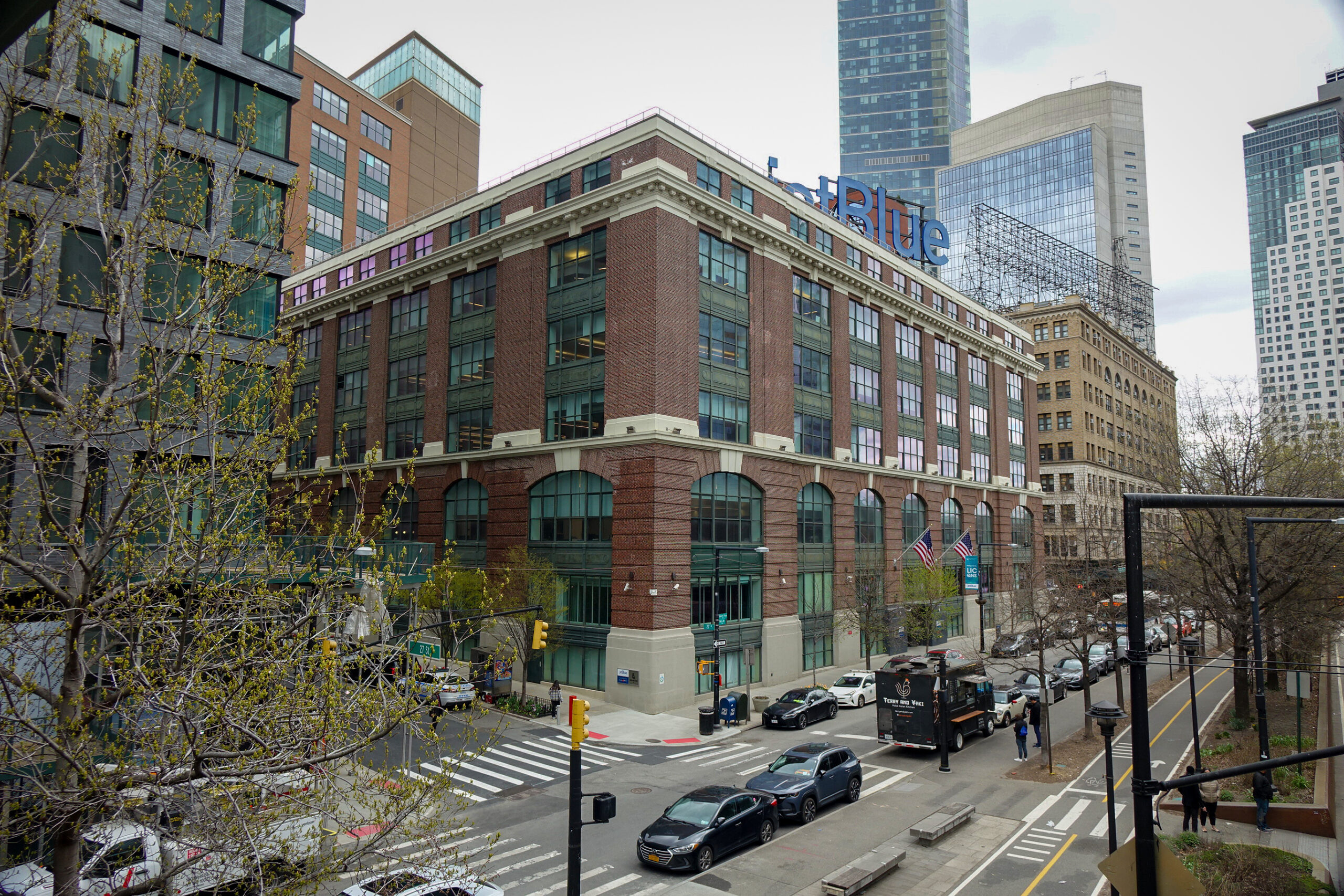
Many car assembly plants built aircraft during World War II in the U.S., including the 1910s-era Brewster assembly plant in Queens. Most returned to car production, but this particular brick building, a short hop from the Queensboro Bridge, managed to stay in the aviation world. Today, it’s the world headquarters of quasi-budget air carrier JetBlue.
It got its start when coachbuilder Brewster outgrew its Manhattan plant in the first decade of the 20th century. The company was highly regarded for putting sensational bodies on Rolls-Royce and Simplex chassis, which were gobbled up by the country’s wealthiest buyers in the Roaring ‘20s. By 1925, Brewster was acquired by Rolls-Royce, though the Great Depression soon decimated production of high-end vehicles. Brewster pivoted to gorgeous bodies on Ford V-8 chassis, though by 1937, the plant was idle. Gearing up for war, Brewster’s new aeronautical division shifted to aircraft—though fraud was rampant, and the U.S. government soon took over.


The building managed to survive decades of limited use through the early 1990s, when it was revamped as an office building. JetBlue moved into the facility in 2010, and today the building anchors a revitalizing neighborhood. Ironically, for a city so invested in mass transit, it takes just as long to drive a car from JetBlue’s headquarters to its main hub at JFK International Airport as it does to utilize the subway and the AirTrain. (Trust me—you should still take the trains, however.)
link